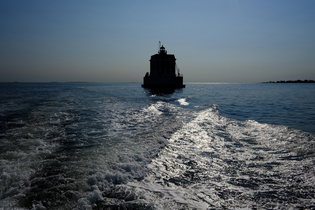
It is a point on a chart. It is a building, alone in the sea, on a tiny manmade island. It is an aid to navigation. It is a symbol of maritime New London. It is New London Ledge Lighthouse.
Perched out in Fishers Island Sound, at the mouth of the Thames River, Ledge Light has served us for a century.
This is its story.
Around 1900, the Lighthouse Board determined that the increased boat traffic to New London harbor warranted a new lighthouse to supplement New London Harbor Light, upriver on Pequot Avenue.
Building of the lighthouse was authorized by the United States Senate in 1906 and in 1908 the contract to build the structure was awarded to the T.A. Scott Company of New London. Total cost allocated for the project was not to exceed $115,000.
Completed in 1909, the lighthouse was originally named Southwest Ledge; however, to avoid confusion with a lighthouse having the same name in New Haven harbor, the name was changed to New London Ledge Light.
The unique three-story, eleven room brick and granite design of the house came about as result of the influence of Edward Harkness and Morton Plant, two wealthy home owners in Waterford and Groton. They wanted the lighthouse to be representative of the styles of their homes. Architects came up with a design incorporating both Colonial Revival and French Second Empire styles.
Ledge Lighthouse was originally equipped with a fourth-order Fresnel lens, made in France, now on display at the Custom House in New London. It is a jewel, a piece of art wrought in glass and light. The characteristic of the beacon was three white flashes followed by a red flash every thirty seconds.
The lighthouse was placed in operation on November 7, 1909. Three or four-man crews maintained the light and the house, doing the daily polishing, oiling, fueling, painting and repairs that a lighthouse needs.
Their days at the house included plenty of time to read, fish, make music, keep an eye on boats, and contemplate the beauty around them.
And then there is Ernie.
Facts about Ernie are hard to come by, but stories are not. Whether he ever existed is somewhat of a moot point by now. He has grown in legend and is so associated with Ledge Light that he might as well be real.
According to the legend, Ernie was a keeper, probably in the 1920s or 30s. His younger wife, who lived ashore, ran off with the Captain of the Block Island Ferry.
Consumed with grief and loneliness, Ernie allegedly climbed to the roof of the lighthouse and jumped. His body was never found. But his business with Ledge Light was not done.
Legend has it that Ernie haunts the lighthouse to this day. He sometimes turns on the foghorn on clear days. There are cold spots inside. Strange noises, whispers. Boats are mysteriously untied. All manner of occurrences have been ascribed to Ernie.
Ernie is as real as we want him to be.
Ledge Light continued on with keepers coming
and going and the years spinning by. It survived the 1938 hurricane, when waves crashed up to the second floor and the keepers took refuge in the lantern room. The lighthouse was automated, and in 1987, the keepers left.
Still an active aid to navigation, Ledge Lighthouse continues to serve mariners as it did for a century. It is a unique building with a unique history.
In the fall of 2014, thanks to the hard work of the Foundation, the deed to the lighthouse was transferred from the Coast Guard to the New London Maritime Society, who owns Race Rock and the New London Harbor Light. We wanted to keep the light in local hands.
The Ledge Light Foundation will lease the lighthouse from the Maritime Society and continue its decades of stewardship.
In the Spring of 2018, after almost 10 years at the helm of the Ledge Light Foundation, Todd and Marcia Gipstein handed over the wheel with the hope that the enormous progress they made on restoration, the museum, and public access will continue.